
Gregorian Chants
Sacred Sounds and Silence
The Roots of Western Sacred Music
Gregorian chants are among the oldest surviving forms of sacred vocal music in the Western world. Emerging from the monasteries and churches of medieval Europe, these chants were traditionally sung in Latin as part of prayer, liturgy, contemplation, and communal worship. Their slow, flowing melodies continue to resonate deeply with listeners today — not only within religious settings, but also within meditation, mindfulness, and sound-based contemplative practices.
At Sacred Syllable, Gregorian chants are approached with respect for their Christian origins while also recognizing their broader relationship to sound, resonance, breath, and the human search for stillness. Like many sacred sound traditions around the world, Gregorian chants reflect a timeless understanding that the human voice can shape consciousness, calm the nervous system, and create a bridge between silence and meaning.
Gregorian chants are not merely music in the modern sense. They are prayers carried through tone, rhythm, vibration, and breath.
What Are Gregorian Chants?
Gregorian chants are a form of monophonic sacred singing associated with the Roman Catholic Church. “Monophonic” means that all voices sing a single melodic line together, without harmony or instrumental accompaniment. The result is spacious, uncluttered, and deeply meditative.
Traditionally sung in Latin, Gregorian chants were used throughout the Mass and the Divine Office — the cycle of daily prayers observed within monastic communities. The chants often draw directly from scripture, particularly the Psalms, allowing sacred texts to unfold slowly through sound and breath.
Unlike modern music built around strict beats and repetitive structures, Gregorian chants flow freely with the natural cadence of language. Their rhythms follow the words themselves rather than a fixed tempo. This free-flowing quality contributes greatly to the chants’ calming and contemplative atmosphere.
Gregorian Chants and the Living Voice
Though centuries old, Gregorian chants remain alive through communities, monasteries, scholars, choirs, and listeners who continue to preserve and study the tradition today.
Their endurance speaks to something deeply human — the impulse to give voice to reverence, longing, stillness, grief, beauty, and devotion through sound itself.
Whether heard within a cathedral, a monastery, headphones at dawn, or during quiet reflection at home, Gregorian chants continue to offer a rare sonic space where simplicity and depth meet.
Within the broader exploration of Sacred Syllable, Gregorian chants stand as one thread in a much larger tapestry of sacred sound traditions — reminding us that across cultures and centuries, the human voice has long been used as a bridge between the visible and invisible worlds.
The Origins of Gregorian Chants
Gregorian chants developed primarily during the 9th and 10th centuries in Western and Central Europe, though their roots extend further into earlier Christian, Jewish, and regional liturgical traditions.
The chants are traditionally associated with Pope Gregory I, also known as Gregory the Great. While legend once claimed that he personally composed the chants through divine inspiration, modern scholarship suggests the tradition evolved gradually through centuries of oral transmission and liturgical refinement.
The development of Gregorian chants reflects a convergence of multiple influences:
• Early Christian liturgical singing
• Jewish psalmody and synagogue traditions
• Roman liturgical music
• Gallican chant traditions from what is now France
• Byzantine and Greek melodic influences
Over time, these traditions were organized and standardized throughout the Carolingian Empire, eventually becoming the dominant sacred music tradition of medieval Western Christianity.
The Salve Regina (“Hail Holy Queen”) is one of the most well-known Gregorian chants within the Western Christian tradition.
Traditionally sung in Latin and dedicated to the Virgin Mary, it has been used for centuries in prayer, devotion, and contemplative worship.
Salve Regina
Latin
Salve, Regina, mater misericordiae,
vita, dulcedo, et spes nostra, salve.
Ad te clamamus, exsules filii Hevae.
Ad te suspiramus, gementes et flentes
in hac lacrimarum valle.
Eia ergo, Advocata nostra,
illos tuos misericordes oculos
ad nos converte.
Et Jesum, benedictum fructum ventris tui,
nobis post hoc exsilium ostende.
O clemens, O pia, O dulcis Virgo Maria.
Transliteration (Phonetic)
SAHL-veh reh-JEE-nah, MAH-ter mee-zeh-ree-KOR-dee-eh
VEE-tah, dool-CHAY-doh, et spes NOS-trah, SAHL-veh
AHD tay klah-MAH-moos, EKS-soo-les FEE-lee-ee EH-veh
AHD tay soo-spee-RAH-moos, jeh-MEN-tes et FLEN-tes
een hahk lah-kree-MAH-room VAHL-leh
AY-ah ER-go, ahd-voh-KAH-tah NOS-trah
EEL-los TOO-ohs mee-zeh-ree-KOR-des OH-koo-los
ahd nohs kon-VEHR-teh
et YAY-soom, beh-neh-DEEK-toom FROOK-toom VEN-trees TOO-ee
NOH-bees post hok eks-SEE-lee-oom oh-STEN-deh
oh KLEH-mens, oh PEE-ah, oh DOOL-chees VEER-go mah-REE-ah
Translation (English)
Hail, Holy Queen, Mother of Mercy,
our life, our sweetness, and our hope.
To thee do we cry, poor banished children of Eve.
To thee do we send up our sighs, mourning and weeping
in this valley of tears.
Turn then, most gracious Advocate,
thine eyes of mercy toward us,
and after this our exile, show unto us
the blessed fruit of thy womb, Jesus.
Show Him unto us after this exile.
O clement, O loving, O sweet Virgin Mary.
Listening as Practice
At Sacred Syllable, Gregorian chants are approached as part of a broader exploration into sacred sound, vibration, and contemplative listening traditions from around the world. Rooted in Christian monastic practice, these chants continue to resonate through their simplicity, spaciousness, and relationship between breath, voice, and silence.
Gregorian chants invite a quieter form of listening. Their slow pacing, flowing melodies, and sustained vocal tones encourage attention to breath, resonance, and the emotional atmosphere created through sound itself.
Beyond historical or religious context, Gregorian chants can also be experienced as a gentle practice of reflection, presence, and inward awareness. Their timeless qualities continue to offer moments of stillness and contemplation for listeners today.
Gregorian Chants, Breath, and Resonance
Across many spiritual traditions, breath and sound are deeply connected. Gregorian chants reflect this relationship in profound ways.
The long vocal tones naturally encourage slower breathing patterns and sustained exhalation. This can produce a calming effect on the body and nervous system. Many listeners describe Gregorian chants as grounding, spacious, peaceful, or timeless — qualities also associated with meditative and contemplative states.
Within monasteries, Gregorian chants were never intended as performances alone. They were lived spiritual practices woven into daily cycles of prayer, silence, devotion, and communal rhythm. The voice became an instrument of inward orientation.
This understanding of sacred sound echoes many traditions explored throughout Sacred Syllable:
• Vedic mantra recitation
• Buddhist chanting
• Sufi devotional singing
• Indigenous ceremonial songs
• Hebrew cantillation
• Daoist tonal practices
• Islamic prayer recitation
While these traditions emerge from distinct cultural and theological foundations, they often share an understanding that vibration and intentional vocalization can influence consciousness, emotion, and awareness.
The Influence of Gregorian Chants
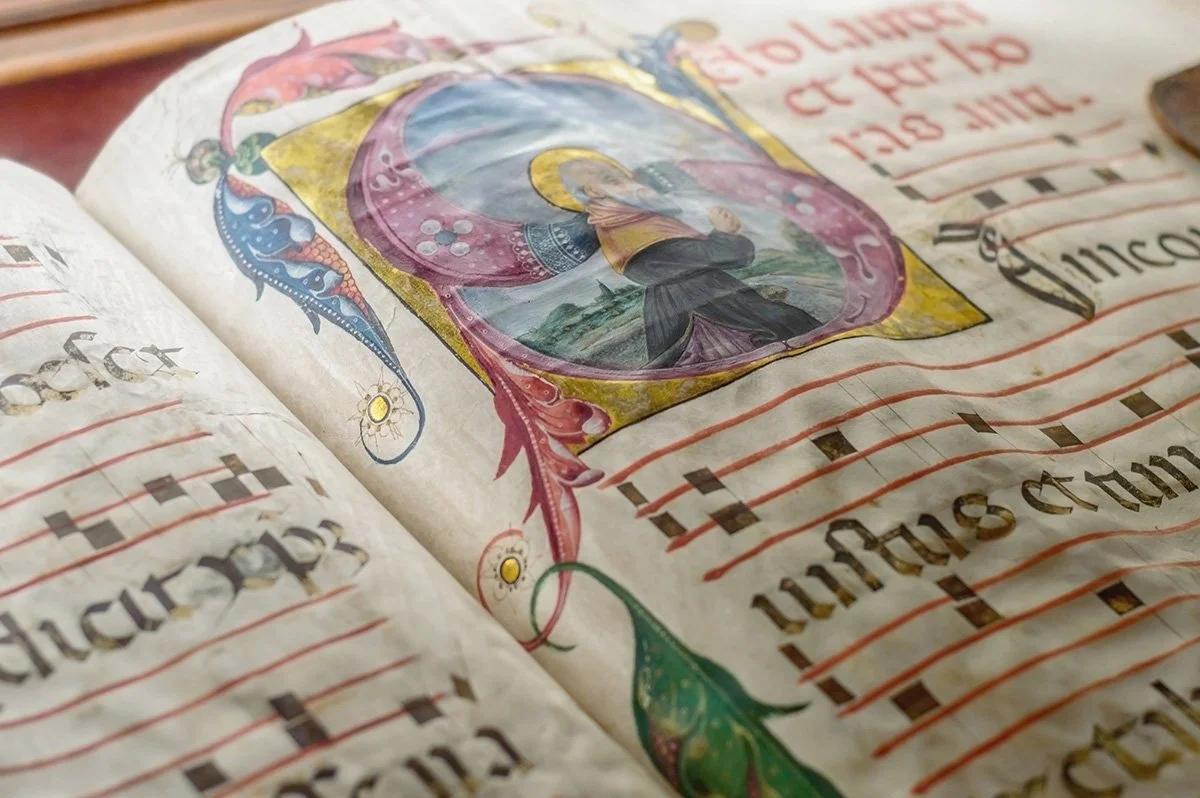
Gregorian chants form one of the foundational roots of Western musical development. Early systems of musical notation were created in part to preserve chant traditions that had previously been passed down orally, eventually evolving into the staff notation still used in Western music today.
From Gregorian chants emerged many later developments in sacred and classical music, including medieval polyphony, Renaissance choral music, sacred motets and masses, Western choir traditions, and early modal and harmonic theory. These chants helped shape the structure and evolution of Western sacred music for centuries.
Even modern ambient, cinematic, and meditative music continues to draw from the spacious tonal qualities associated with Gregorian chants. Their slow pacing, vocal resonance, and contemplative atmosphere continue to influence musicians, composers, and listeners seeking simplicity, depth, and reflection through sound.
The Structure of Gregorian Chants
One of the defining qualities of Gregorian chants is their simplicity. The absence of instruments and harmonic layering creates an open sonic space that allows listeners to focus on tone, breath, and resonance.
Several core elements shape the sound of Gregorian chants:
Monophonic Voice
All singers move together in one melodic line. This creates a unified field of sound rather than separate vocal parts.
Modal Melodies
Gregorian chants are built upon medieval modes rather than modern major and minor scales. These modal structures contribute to the chants’ ancient, spacious, and emotionally ambiguous qualities.
Free Rhythm
Gregorian chants follow the natural rhythm of sacred language instead of fixed meter. The chants breathe with the text itself.
Sacred Language
Latin serves as the primary liturgical language of Gregorian chants, though occasional Greek phrases appear in older traditions. The continuity of language helped preserve a unified sacred musical tradition across regions and centuries.
Gregorian Chants and Silence
Gregorian chants are inseparable from silence.
The pauses between phrases are as important as the notes themselves. In many monastic traditions, silence was cultivated not as emptiness, but as receptivity — a way of listening more deeply.
The chants emerge from silence and eventually dissolve back into it.
This relationship between sound and silence remains central to contemplative practices around the world. Sound becomes a doorway rather than a destination. Gregorian chants do not attempt to overwhelm the listener. Instead, they gently guide attention inward.
In this way, Gregorian chants can be understood not only as sacred music, but also as forms of sonic contemplation.