
Zen Chants
Sound, Breath, and Presence
Chanting in Mahāyāna Buddhism
Zen chanting is part of a long contemplative tradition rooted within Mahāyāna Buddhism — a broad stream of Buddhist practice emphasizing wisdom, compassion, meditation, and the awakening of all beings. As Buddhism traveled from India into China, Korea, Japan, and Vietnam, chanting traditions evolved alongside meditation, ritual, and monastic life, eventually becoming integrated into what is now known as Zen Buddhism.
Known as Chán in China and Zen in Japan, this lineage emphasizes direct experience, simplicity, mindfulness, and insight beyond conceptual thought. While seated meditation, or zazen, often stands at the center of Zen practice, chanting has also remained an important part of daily life within monasteries, temples, and lay communities for centuries.
At Sacred Syllable, Zen chants are approached as part of a broader exploration into sacred sound, contemplative listening, breath awareness, and the relationship between vibration and consciousness.

Chanting as Practice
In Zen traditions, chanting is generally not approached as performance or entertainment. Instead, chants are recited in a steady and attentive rhythm that unifies breath, voice, posture, and awareness into a single practice.
The repetition of sutras, dhāraṇīs, gāthās, and sacred phrases gradually quiets discursive thought while cultivating concentration, mindfulness, and presence. Over time, the chant becomes less about intellectual analysis and more about embodiment, listening, rhythm, and direct participation within the living Dharma.
The voice itself becomes part of meditation.
In many Zen temples and monasteries, chanting is practiced daily alongside seated meditation, bowing, silence, mindful work, and ceremonial practice. The cadence of collective recitation creates a shared atmosphere of attentiveness and stillness, helping practitioners return to the immediacy of breath and sound.
Within these traditions, chants such as the Maha Prajna Paramita Heart Sutra continue flowing through meditation halls and temples across generations:
“Gate Gate Paragate Parasamgate Bodhi Svaha.”
The chant becomes less about translation alone and more about rhythm, breath, resonance, and direct experience.
In this space, the voice becomes practice. Breath becomes realization. Sound becomes a way of entering silence rather than escaping it.
Awakening Together
Many Zen chants emphasize not only personal awakening, but collective awakening. Practice unfolds in relationship with community, teachers, ancestors, and all beings moving through life together.
This spirit appears within chants such as Awakening Together²:
“All awakened ones
throughout space and time,
honored ones, great beings,
who help all to awaken,
together may we realize
wisdom beyond wisdom!”
The communal nature of chanting helps dissolve the sense of isolated selfhood. Individual voices merge into shared rhythm, shared breath, and shared attention.
Through repetition and collective recitation, practitioners participate in an atmosphere that is simultaneously personal and universal — grounded in the present moment while connected to centuries of contemplative tradition.
Atonement and Self-Reflection
Zen chanting traditions also include chants of reflection, humility, and atonement. These recitations acknowledge the ways human beings create suffering through greed, anger, ignorance, and unconscious action.
One of the most widely recited examples is the Atonement² chant:
“For all my unwholesome actions since olden times,
from my beginningless greed hatred and ignorance,
born of my body speech and thought,
I now fully atone.”
Rather than functioning through guilt or punishment, these chants encourage honest awareness, accountability, compassion, and renewed intention. Through repetition and reflection, practitioners are invited to recognize harmful patterns while cultivating greater mindfulness in thought, speech, and action.
Within Zen practice, atonement is not viewed as self-condemnation, but as a sincere acknowledgment of human imperfection and interconnectedness. The chant becomes a practice of humility, clarity, and returning once again to the present moment.
Sound and Silence
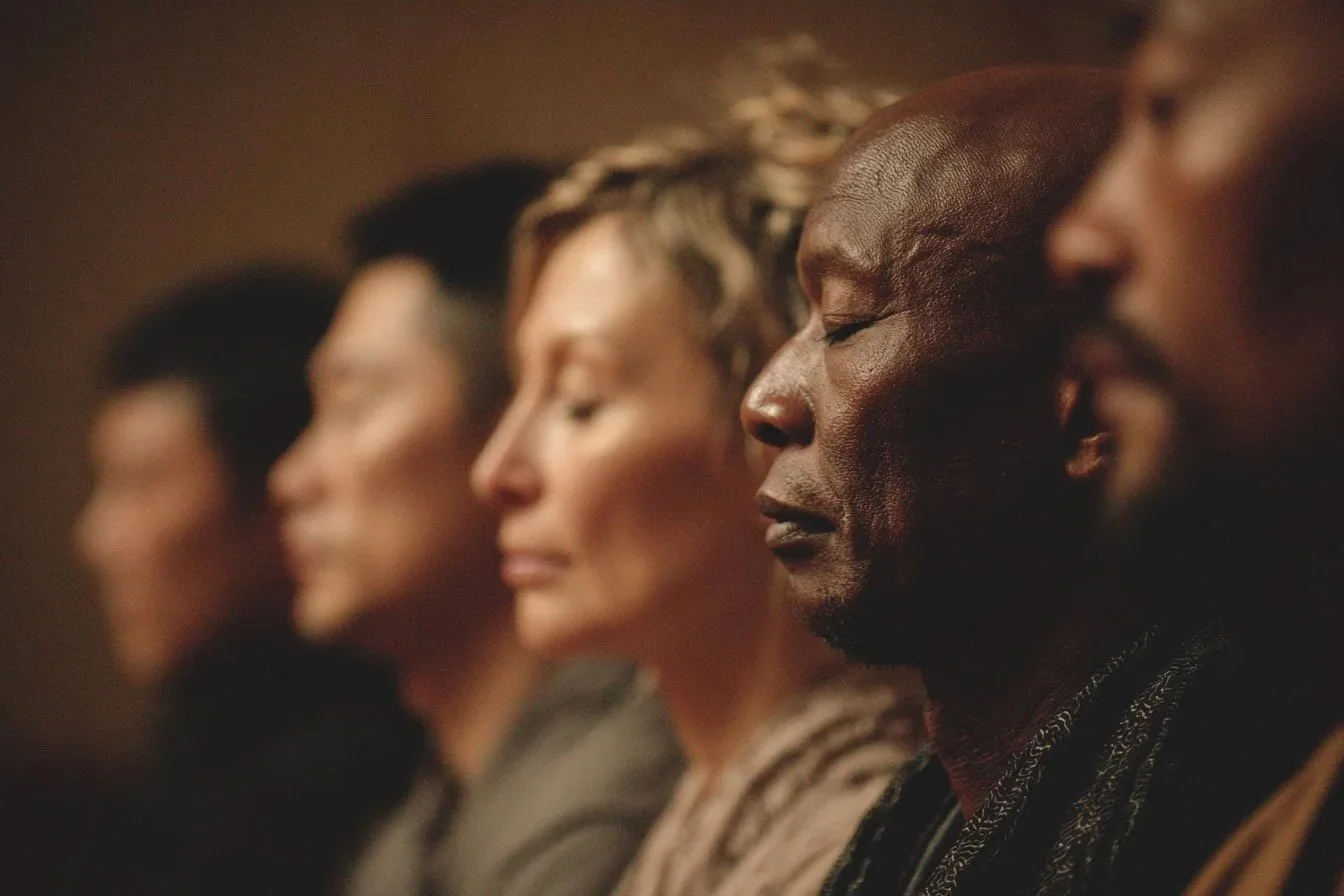
Zen chanting exists within a dynamic relationship between sound and silence. Pauses, stillness, and spaciousness are considered just as important as the recited syllables themselves.
Rather than filling silence, chants emerge from it and eventually dissolve back into it.
Within this relationship, practitioners may begin noticing subtler dimensions of listening — the texture of breath, the resonance of the body, the atmosphere created by collective recitation, and the quiet awareness beneath thought.
In this way, Zen chants are not merely musical forms or religious recitations. They become contemplative practices of attention, listening, rhythm, and presence.
The Heart Sutra and Emptiness
Among the most recognized chants within Mahāyāna Buddhism and Zen practice is the Maha Prajna Paramita Heart Sutra¹, often referred to simply as the Heart Sutra. Concise yet profound, it explores emptiness, wisdom, impermanence, and the interdependent nature of existence.
Its opening lines immediately establish the contemplative atmosphere of the chant:
“Avalokiteshvara Bodhisattva, doing deep Prajna Paramita, clearly saw emptiness of all the five conditions, thus completely relieving misfortune and pain.”
The sutra gradually dissolves attachment to fixed concepts and categories:
“Form is exactly emptiness, emptiness exactly form.”
“No eye, ear, nose, tongue, body, mind.”
“No suffering, no cause of suffering, no extinguishing, no path.”
Far beyond philosophical abstraction, the Heart Sutra is often experienced through direct recitation and attentive listening. The steady movement of breath and voice allows practitioners to enter the chant physically, rhythmically, and contemplatively.
The concluding mantra remains one of the most widely recognized within Mahāyāna Buddhism:
“Gate! Gate! Paragate! Parasamgate! Bodhi Svaha!”
Within Zen practice, the Heart Sutra is not approached merely as doctrine, but as living practice — an invitation into spaciousness, awareness, and compassionate presence.
The Relative and the Absolute
Another well-known Zen chant, Identity of the Relative and Absolute¹, explores the relationship between duality and unity, form and emptiness, individuality and interconnectedness.
“The mind of the great sage of India was intimately conveyed from West to East.”
Its verses reflect the subtle balance between ordinary life and deeper realization:
“To be attached to things is illusion, to encounter the absolute is not yet enlightenment.”
“Within light there is darkness, but do not try to understand that darkness. Within darkness there is light, but do not look for that light.”
Zen chanting often points beyond rigid conceptual thinking while remaining deeply grounded in direct experience. Rather than separating spiritual practice from ordinary life, the chant continually returns awareness to the immediacy of the present moment.
Through its rhythmic recitation, practitioners are invited to contemplate the interwoven nature of opposites — stillness and movement, silence and sound, self and other. The ordinary world itself becomes the field of awakening.
“Ordinary life fits the absolute as a box and its lid.”
The chant continually returns practitioners to immediacy — not somewhere beyond life, but directly within it.
“If you do not see the Way, you do not see it even as you walk on it.”
Zen Chants and Sacred Sound
At Sacred Syllable, Zen chants are honored as part of a broader exploration into sacred sound traditions from around the world. Alongside Gregorian chants, mantras, Indigenous song traditions, prayer calls, and contemplative vocal practices, Zen chanting reflects humanity’s enduring relationship with vibration, breath, awareness, and silence.
While traditions differ in language, symbolism, and cultural expression, many share a common recognition: sound has the capacity to gather attention, calm the mind, deepen presence, and reconnect individuals with the living rhythms of life.
Through chanting, listening, and contemplative awareness, sound gradually becomes more than something heard externally. It becomes something participated in directly.
Zen Mountain Monastery Liturgy Manual. Dharma Communications, 1998.
Tanahashi, Kazuaki. Zen Chants: Thirty-Five Essential Texts with Commentary. Shambhala Publications, 2015.