
The Five Daily Prayer Calls in Islam
A Sacred Rhythm of Sound, Time, and Awareness
A Daily Cycle of Returning
There are five set times for prayer in Islam.
They follow the path of the sun, from the first light of dawn to the quiet of night.
In many places, like Saudi Arabia, this rhythm is part of everyday life. The call to prayer can be heard throughout the day, moving through neighborhoods and across open space.
Each call is known as the Adhān—an invitation to pause, to remember, and to return.
This page explores all five daily calls, with special attention to the first: Fajr, the call at dawn.
The Structure of the Adhān
The Adhān follows the same basic pattern each time, beginning with a declaration of greatness and moving into witness and remembrance. It then calls people toward prayer and toward what is good, before closing with a return to unity.
This repetition is intentional, with a steady rhythm that carries meaning not only through the words, but through the sound itself. At dawn, there is one added line that sets the Fajr call apart.
A Rhythm Rooted in the Sun
The five daily prayer calls are not fixed to a clock. They follow the sun.
Because of this, their timing shifts slightly each day, adjusting with the seasons. The rhythm is not mechanical—it is natural.
Dawn arrives earlier or later. Midday shifts. Sunset changes.
The calls move with these changes, staying aligned with the world as it is, rather than forcing life into a fixed schedule.
Over time, this creates a living rhythm—one that connects the individual to the environment, to time, and to the larger cycle of day and night.
Bringing This into Practice
Engaging with the five daily prayer calls does not require changing one’s path. It begins with listening—listening to the timing, to the sound, and to the distinct quality each call carries.
Fajr invites awakening, Dhuhr invites balance, Asr invites reflection, Maghrib invites transition, and Isha invites rest.
These movements are universal. They unfold within every day, whether named or not.
The Five Daily Prayer Calls
The first prayer of the day is Fajr — The Dawn Call.
Fajr takes place before sunrise, at the first light on the horizon—a quiet hour, often untouched by noise or movement, when the world is still in transition.
The Adhān for Fajr includes a line not found in the other calls: “Prayer is better than sleep.” It is a simple phrase, but it carries weight, speaking to a moment we all recognize—the pull to remain at rest, and the invitation to rise.
Fajr is not only about beginning the day, but about how we begin: with awareness, with intention, and with a willingness to meet the day before it fully unfolds.
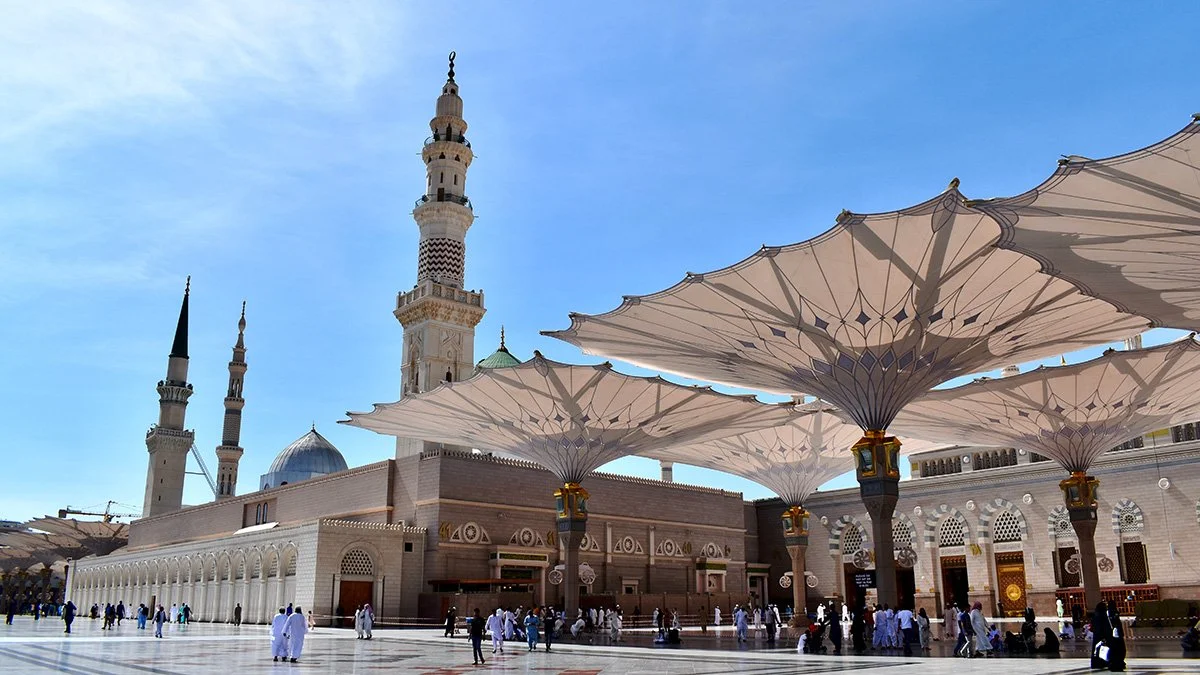
Al Masjid an-Nabawi, Medina, Saudi Arabia
الأذان
الله أكبر، الله أكبر
الله أكبر، الله أكبر
أشهد أن لا إله إلا الله
أشهد أن لا إله إلا الله
أشهد أن محمدًا رسول الله
أشهد أن محمدًا رسول الله
حي على الصلاة
حي على الصلاة
حي على الفلاح
حي على الفلاح
الصلاة خير من النوم
الصلاة خير من النوم
الله أكبر، الله أكبر
لا إله إلا الله
Transliteration (Phonetic)
Allāhu akbar, Allāhu akbar
Allāhu akbar, Allāhu akbar
Ashhadu an lā ilāha illa Allāh
Ashhadu an lā ilāha illa Allāh
Ashhadu anna Muḥammadan rasūl Allāh
Ashhadu anna Muḥammadan rasūl Allāh
Ḥayya ʿalaṣ-ṣalāh
Ḥayya ʿalaṣ-ṣalāh
Ḥayya ʿalal-falāḥ
Ḥayya ʿalal-falāḥ
Aṣ-ṣalātu khayrun mina n-nawm
Aṣ-ṣalātu khayrun mina n-nawm
Allāhu akbar, Allāhu akbar
Lā ilāha illa Allāh
Translation (English)
God is the Greatest, God is the Greatest
God is the Greatest, God is the Greatest
I bear witness that there is no god but God
I bear witness that there is no god but God
I bear witness that Muhammad is the Messenger of God
I bear witness that Muhammad is the Messenger of God
Come to prayer
Come to prayer
Come to success
Come to success
Prayer is better than sleep
Prayer is better than sleep
God is the Greatest, God is the Greatest
There is no god but God
Dhuhr — The Midday Call
As the sun reaches its highest point, the second call to prayer arrives: Dhuhr. It comes in the middle of the day, when activity is at its peak—work is underway, the mind is engaged, and the body is in motion.
The call to Dhuhr creates a pause. It doesn’t stop the world, but it offers a moment to step back and remember that even in the busiest part of the day, there is still space for awareness.
In Saudi Arabia and other parts of the world, shops may close briefly and people step away from their tasks. The rhythm of daily life softens, even if only for a short time.
Dhuhr brings balance. It centers the day and gently calls us to return.
Asr — The Afternoon Call
The third prayer, Asr, comes in the later part of the afternoon, as the intensity of midday begins to ease. The light softens, and the day starts to lean toward evening, bringing with it a quieter shift in pace.
Asr carries a reflective quality. It offers a moment to take stock—to notice what has unfolded, to feel the passage of time, and to reconnect before the day moves further on.
At this hour, the call gently grounds the moment, drawing attention back to the present—not with urgency, but with awareness.
Maghrib — The Sunset Call
As the sun sets, the fourth prayer begins: Maghrib. It arrives at one of the most visually striking moments of the day, as the sky shifts in color, the light fades, and the boundary between day and night becomes visible.
The call to prayer at this hour carries a sense of transition. The day begins to close—what was active starts to settle, and what was bright becomes quiet.
Maghrib is often brief, but it is deeply felt, marking a clear turning point both outwardly and within.
Isha — The Night Call
The final prayer of the day is Isha, offered at night, when the world has slowed and the sky has gone dark. By this time, the day’s activity has come to a close, and the atmosphere feels settled and quiet.
The call to Isha carries no urgency. It feels grounded and complete—a gentle closing to the day. It offers a final moment of awareness before rest, a chance to reflect, release, and prepare for sleep.
In this way, the daily cycle comes full circle, moving from the first light of Fajr to the stillness of night.
Sound as a Path of Awareness
The Adhān is carried by the human voice. It is not rushed or forced, but offered with care. Each phrase rises and falls with intention, and the pauses hold as much meaning as the words themselves. Through repetition, a steady field of attention begins to form.
Even without understanding the language, its effect can be felt. The sound draws the mind inward, the rhythm steadies the breath, and the space between phrases allows awareness to settle.
For the Sacred Syllable, this is where sound becomes meaningful—not only as language, but as vibration, tone, and presence.
Closing Reflection
The five daily prayer calls in Islam offer a structure that is both simple and profound. They divide the day not to fragment it, but to bring it back together, offering steady points of return.
Each call becomes a moment to pause, and each sound an invitation into awareness.
At the beginning of it all is Fajr—the quiet call before sunrise, a gentle reminder that something is always beginning again.
May this be received in peace.