
Qawwali: The Path of Devotional Sound
Sacred Music and the Mystical Tradition of the Heart
What Is Qawwali?
Qawwali is a sacred form of devotional music rooted in the mystical traditions of Sufism, most commonly associated with Pakistan and India. More than a musical genre, Qawwali is centered on remembrance, longing, surrender, and the opening of the heart through sound.
For centuries, Qawwali has been performed within shrines, gatherings, and devotional assemblies where music serves as a bridge between the human soul and the Divine. Through poetry, rhythm, repetition, and voice, the music invites listeners into a shared emotional and spiritual experience.
The word “Qawwali” comes from the Arabic word qawl, meaning “utterance” or “sacred saying.” Within Sacred Syllable, Qawwali is honored as part of a wider exploration into sacred sound traditions that understand vibration, music, and the spoken word as pathways toward contemplation, healing, and unity.
The Sufi Roots of Qawwali
Qawwali is deeply connected to Sufism, the mystical dimension of Islam that emphasizes direct experience of Divine love through remembrance, humility, devotion, poetry, and inner transformation.
In many Sufi traditions, music is viewed as a means of awakening the heart. Through repeated phrases and emotional intensity, listeners are encouraged to move beyond ordinary awareness and enter states of reflection, gratitude, longing, or spiritual ecstasy.
Qawwali became closely associated with the Chishti Sufi order in South Asia, where devotional music gatherings known as sama‘ developed into important communal practices.
One of the most influential historical figures connected to Qawwali is Amir Khusrau, the 13th-century poet and musician often credited with helping shape the fusion of Persian, Arabic, Turkic, and Indian musical influences that became foundational to the tradition.
Qawwali and the Sacred Syllable
Within Sacred Syllable, Qawwali is approached not as a cultural artifact frozen in time, but as a living tradition of sacred sound. The music offers insight into how rhythm, repetition, poetry, and voice can create spaces for contemplation, remembrance, and healing within modern life.
At a time when much of the world feels increasingly fragmented and overstimulated, Qawwali reminds us of the importance of listening deeply, gathering in community, remembering the sacred through sound, and returning to silence through vibration.
Qawwali stands alongside many sacred sound traditions around the world that understand music as more than performance alone. Within these traditions, music may become prayer, meditation, emotional release, devotion, collective remembrance, and a bridge between worlds.
Sound as Remembrance
At the heart of Qawwali is remembrance.
The repetitive nature of the music is intentional, with phrases often sung again and again as the emotional intensity gradually builds. This repetition helps focus attention, soften distraction, and draw awareness inward.
This process shares similarities with many sacred sound traditions around the world, including mantra recitation, Buddhist chanting, Gregorian chant, Indigenous ceremonial singing, Hebrew cantillation, Daoist vocal practices, and Nāda Yoga teachings centered on sacred vibration and sound. Across cultures, sacred music often emerges from the understanding that sound can shape consciousness.
Within Qawwali, the human voice becomes the primary instrument through which longing, devotion, and surrender are expressed. Even when listeners do not understand every word being sung, they may still feel moved by the emotional sincerity and energetic depth carried within the performance.
رنگ دے مولا
رنگ دے مولا، اپنے عشق کے رنگ میں
(رنگ دے مولا!)
نور کی چادر، اپنی لَو میں بھر دے
(رنگ دے مولا!)
اپنی ہی موج میں مجھ کو تو اتار دے
(رنگ دے مولا!)
ہر ایک سانس پکارے تیرا نام
(پکارے تیرا نام!)
بس ایک نظر ہو، پورا ہو انجام
(پورا ہو انجام!)
سجدہ کروں میں، صبح ہو یا شام
(پکارے تیرا نام!)
عشقِ الہی، میرا راہ اور مقام
(پورا ہو انجام!)
در پہ کھڑا ہوں، تھک گیا ہے قدم
(پکارے تیرا نام!)
اب تو دکھا دے، اپنا وہ تجلی
مٹ جائے ہستی، ہو جاؤں فنا فی مولا
(من کنت مولا۔۔۔)
رنگ دے مولا۔۔۔ اپنے رنگ میں
بس ایک نظر۔۔۔ بس ایک نظر
Transliteration (Phonetic)
Rang de Maula, apne ishq ke rang mein
(Rang de Maula!)
Noor ki chaadar, apni lau mein bhar de
(Rang de Maula!)
Apni hi mauj mein mujh ko tu utaar de
(Rang de Maula!)
Har ek saans pukaare tera naam
(Pukaare tera naam!)
Bas ek nazar ho, poora ho anjaam
(Poora ho anjaam!)
Sajda karun main, subah ho ya shaam
(Pukaare tera naam!)
Ishq-e-Ilahi, mera raah aur maqaam
(Poora ho anjaam!)
Dar pe khada hoon, thak gaya hai qadam
(Pukaare tera naam!)
Ab to dikha de, apna woh tajalli
Mit jaaye hasti, ho jaaun fana fi Maula
(Man kunto Maula...)
Rang de Maula... apne rang mein
Bas ek nazar... bas ek nazar
Translation (English)
Color me, O Lord, in the color of Your love
(Color me, O Lord!)
Wrap me in a cloak of light, filled with Your flame
(Color me, O Lord!)
Carry me into the flow of Your own ecstasy
(Color me, O Lord!)
Every breath calls out Your name
(Calls out Your name!)
Just one glance from You, and destiny is fulfilled
(Destiny is fulfilled!)
I bow in devotion, whether morning or evening
(Calls out Your name!)
Divine love is my path and my resting place
(Destiny is fulfilled!)
I stand at Your doorway; my feet have grown weary
(Calls out Your name!)
Now reveal that radiant manifestation of Yours
Let the self dissolve, let me become annihilated in the Beloved
(“Man Kunto Maula…”)
Color me, O Lord, in Your color
Just one glance… just one glance
Instruments and Musical Structure
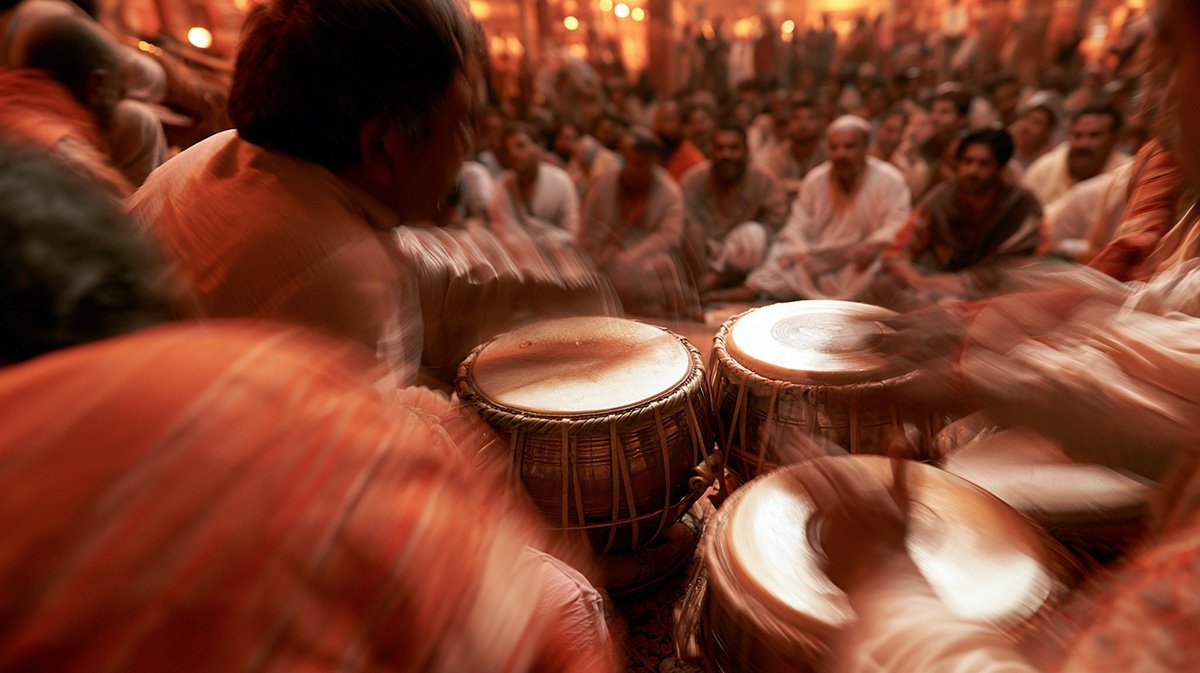
Traditional Qawwali performances often feature a lead vocalist supported by a vocal ensemble, harmonium, tabla, dholak, and rhythmic hand clapping. Together, these elements create the layered atmosphere that has become central to the music.
The harmonium provides the melodic foundation while percussion drives the rhythmic momentum forward. The hand clapping itself becomes part of the spiritual architecture of the performance, grounding the music in collective participation and shared energy.
A Qawwali performance typically begins slowly and contemplatively before building into increasingly energetic passages. Improvisation also plays an important role, with vocalists extending phrases or elaborating upon devotional passages depending on the emotional atmosphere of the gathering.
The goal is not technical perfection alone, but sincerity, presence, and spiritual transmission.
Nusrat Fateh Ali Khan
No modern discussion of Qawwali is complete without acknowledging Nusrat Fateh Ali Khan. Widely regarded as one of the greatest vocalists of the 20th century, Nusrat helped introduce Qawwali to global audiences through recordings, film soundtracks, collaborations, and international performances.
His voice carried extraordinary emotional range, capable of moving from delicate softness to overwhelming intensity within moments. Through his work, many listeners outside South Asia encountered Qawwali for the first time.
Other important figures within the tradition include Sabri Brothers, Abida Parveen, Aziz Mian, and Rahat Fateh Ali Khan.
Poetry, Longing, and Devotion
Qawwali poetry explores themes of Divine love, yearning, separation, union, humility, and surrender. Many poems use the language of earthly love to describe the relationship between the soul and the Divine Beloved.
A listener may hear a love song, a prayer, a meditation on loss, or a mystical teaching hidden within metaphor. Common themes include longing for closeness to God, the pain of separation, spiritual intoxication, dissolution of the ego, and the search for inner truth.
In many performances, emotional intensity gradually builds until the boundaries between performer and audience begin to soften. Hand clapping, call-and-response vocals, and rhythmic repetition help create a communal atmosphere where the gathering itself becomes part of the devotional experience.
Qawwali and Spiritual Ecstasy
One of the most distinctive aspects of Qawwali is its relationship to spiritual ecstasy. Within certain Sufi traditions, music and rhythm are understood to help dissolve the distractions of the mind, allowing moments of emotional release, heightened awareness, or spiritual insight to emerge naturally.
For some listeners, this experience may be deeply internal and quiet. For others, the music may evoke tears, joy, stillness, or a profound sense of connection. The emotional power of Qawwali often comes from its ability to hold paradox — longing and fulfillment, grief and beauty, intensity and surrender.
The music reminds listeners that longing itself can become a sacred path.
The Language of Devotional Music
Even when listeners do not understand the language being sung, Qawwali often communicates something immediate and unmistakably human. The trembling of the voice, the rising rhythm, the repetition of a sacred phrase, and the feeling of longing carried through melody all possess an emotional depth that transcends translation.
In this way, Qawwali reflects something universal about sacred music itself: the human desire to reconnect with meaning, beauty, presence, and one another.
Whether heard within a shrine courtyard, through headphones late at night, or shared among friends in quiet reflection, Qawwali continues to carry forward an ancient understanding — that sound can heal, that music can remember, and that the heart itself may become an instrument of devotion.