
African Sacred Sound Traditions
Voice, Drum, and Memory Across a Continent of Peoples
A Living Field of Sound
Africa is not one tradition but thousands — a continent of distinct languages, peoples, and spiritual lineages, each carrying its own relationship to sound. The drumming of the Ewe, the praise song of the Yoruba, and the liturgical chant of Ethiopia belong to different histories, theologies, and landscapes entirely.
What connects them is not a shared style, but a shared understanding: that voice and rhythm are not separate from daily life or spiritual life. They are how memory is kept, how community is formed, and how the sacred is met. In many of these traditions, there is no word that separates "music" from "prayer" or "history" the way Western language tends to.
This page offers an entry point into that vastness — a few of the traditions that will each, in time, receive their own deeper exploration within the Sacred Syllable.
The Griot, Keeper of Word and Sound
Across West Africa — among the Mande peoples of Mali, Guinea, Senegal, and Gambia — the griot (or jeli) holds a role with no true Western equivalent: historian, musician, genealogist, and spiritual intermediary in one. The position is hereditary, passed down within specific griot families, with children apprenticed to the tradition from a young age, learning not only melody but the enormous store of lineage, proverb, and historical detail the music is built to carry.
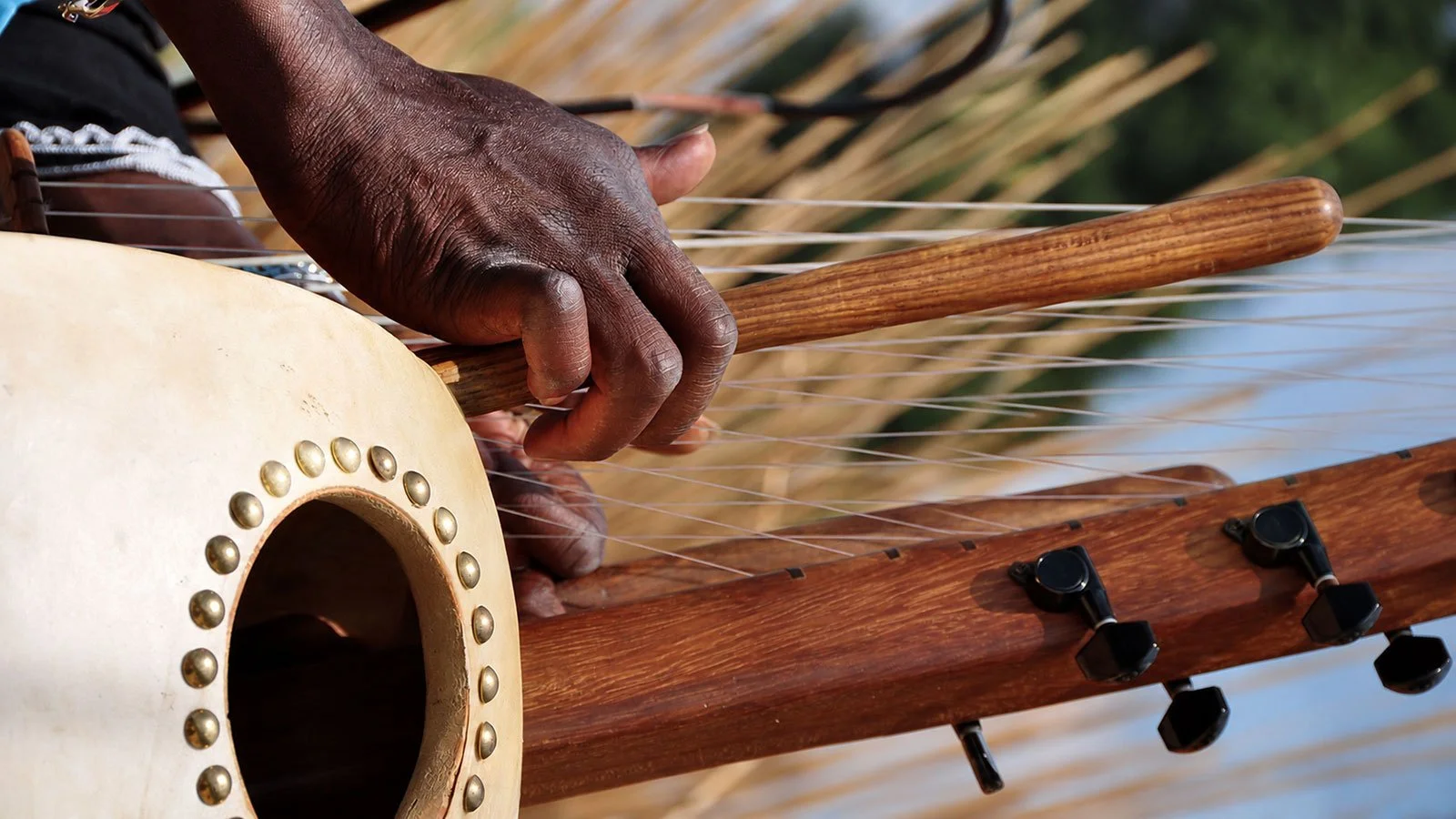
The griot's primary instrument is the kora, a twenty-one string harp-lute built from a large calabash gourd, cowhide, and a long hardwood neck. Its cascading tone accompanies epic recitation and praise-singing alike, unfolding across performances that can run for hours as a griot traces a family's ancestry or recounts the history of an empire in real time.
For the griot, sound is not decoration placed around history. It is the vessel that carries it. A name spoken in song is a name remembered, and a people without griots, the tradition holds, is a people at risk of forgetting itself.
Drumming as Sacred Language
Across much of West and Central Africa, the drum functions as far more than rhythm. Among the Yoruba of Nigeria, the dùndún — the "talking drum" — is built with an hourglass shape and tensioned leather cords a player squeezes under the arm mid-strike, bending the pitch to mimic the tonal contours of spoken Yoruba. Skilled players can communicate actual proverbs, praise names, and messages across a distance, a use of percussion closer to language than to music as it's often understood in the West.
In Ghana, the sacred drumming of the Ewe and Akan peoples carries similarly precise meaning. The Ewe atumpan, a pair of tuned drums, opens royal ceremonies with rhythmic phrases understood as formal speech. Among the Akan, the fontomfrom ensemble accompanies funerals and enstoolment ceremonies, marking the passage between the living and the ancestors.
In these traditions, drumming is rarely a solo act. It is communal by design — call and response, layered polyrhythm, and the entrainment of a whole gathering into a single shared pulse. The drum does not perform for the community. It speaks with it, and often, through it.
Yoruba Praise Song and the Orisha
Within Yoruba spiritual tradition, sacred song is inseparable from devotion to the Orisha — divine forces governing natural elements, human character, and fate, from Ogun's mastery over iron and war to Oshun's rule over rivers, love, and beauty. Each Orisha carries specific rhythms, songs, and praise names (oriki) through which they are called and remembered. Praise singing opens a channel between the human and the divine, with the voice functioning as invocation rather than performance — a summons, not a show.
This tradition traveled far beyond West Africa through the transatlantic slave trade. In Cuba it shaped the sacred music of Santería; in Brazil, Candomblé — devotional forms that preserved Yoruba rhythm and cosmology under conditions designed to erase them, one of the clearest examples anywhere of sacred sound surviving displacement.
Gnawa, Trance and Devotion in North Africa
In Morocco, the Gnawa people — descendants of West African peoples brought north through historic trans-Saharan slave routes — developed a devotional tradition centered on the guembri, a three-string bass lute covered in camel skin, alongside iron castanets called qraqeb whose sharp clatter drives the music's trance-inducing pulse. Gnawa lila ceremonies unfold through the entire night, moving participants through a sequence of spirits, colors, and incense, each tied to its own rhythm and state of consciousness, building steadily toward trance and release.
Gnawa music sits at a crossroads — African in origin, Islamic in devotional framework, shaped by Sufi mysticism, and entirely its own in practice. Within Morocco it remains, first and foremost, a healing ceremony — a reminder that sacred sound traditions are rarely contained by a single lineage or border.
Ethiopian Orthodox Chant and the Ge'ez Liturgy
In the highlands of Ethiopia and Eritrea, one of Christianity's oldest continuous liturgical traditions is carried in Ge'ez chant. Attributed in tradition to the sixth-century saint Yared, this chant system (zema) uses its own distinct notation — melekket symbols placed above the Ge'ez text — and a modal structure unrelated to Western or Byzantine chant, despite all three tracing back to the same early Christian world.
The chant is accompanied by the sistrum (tsenatsel), a metal rattle, and the kebero, a large double-headed drum, alongside ritual dance performed by trained deacons known as debtera. It has remained largely unbroken for over a thousand years, still taught through oral apprenticeship — a reminder that Africa holds some of the world's oldest formally notated sacred music, not only its oral and drum-centered traditions.
Southern Africa, Voice in Community
In Southern Africa, sacred and communal sound often centers on the voice alone. Isicathamiya, the close-harmony a cappella style developed among Zulu migrant workers living in hostels far from home, carries themes of longing and moral reflection through intricate, tightly rehearsed vocal layering — a style later carried to global audiences through groups like Ladysmith Black Mambazo.
More broadly, call-and-response singing across Southern African cultures reflects a spiritual orientation toward interdependence — a way of understanding the self as inseparable from community, often described through the philosophy of ubuntu: I am because we are.
Sound as Continuity
What runs beneath all of these traditions — the griot's kora, the talking drum, Orisha praise song, Gnawa trance, Ge'ez chant, and Southern African harmony — is a common thread: sound as a way of holding what matters. Memory, devotion, healing, and belonging are not separated from music across African traditions. They move through it.
Within the Sacred Syllable, these traditions are honored individually and in depth as this collection continues to grow — each one distinct, each carrying its own history, language, and relationship to the sacred.