
Egyptian Temple Music
The Word Made Sound in the Nile Valley
Long before Logos had a Greek name, the Egyptians were already living inside its meaning. They believed the world itself had been spoken into being — that a god opened his mouth and existence followed. Sound was not a reflection of reality in ancient Egypt. It was understood as one of reality's origins.
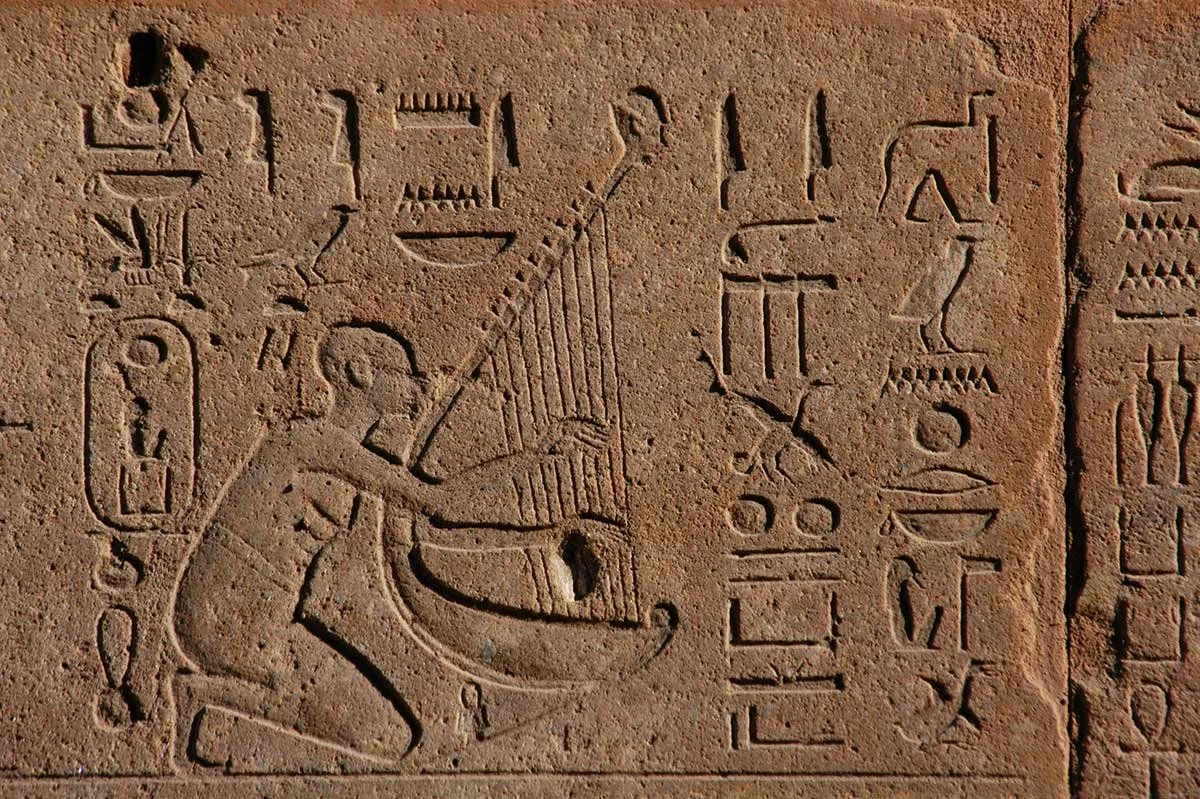
Within Egyptian temples, this belief took daily, physical form. Priests and priestesses chanted hymns, shook the sistrum, plucked the harp, and sang the names of the gods as part of an unbroken liturgical cycle — music not as accompaniment to worship, but as worship itself. At Sacred Syllable™, we approach Egyptian temple music as one thread within a larger tapestry: another culture's testimony that the human voice, given proper form, can move between worlds.
Heka and the Power of Sound
To understand Egyptian temple music, it helps to understand a single, untranslatable word: heka. The word is often translated as "magic," but that doesn't quite capture it. To the Egyptians, heka was the creative force that existed before the world itself — the energy the creator god used to speak the cosmos into being. In one creation story, the god brings himself into existence simply by speaking. Existence answers speech.
This is heka in its purest form: the belief that a spoken word, said with the right intention and tone, doesn't just describe reality. It creates it. Hieroglyphs reflect this same idea. They were called medju netjer, "the words of the god," and were never just an alphabet — they were a living, sacred script. A spell carved in stone carried the same power as one spoken by a trained priest, because for the Egyptians, language and reality were never fully separate things.
To speak a thing's name correctly was to take part in its existence. This is the world that Egyptian temple music comes from. A chant wasn't performed to entertain a god — it was heka in action, sound shaped with precision to help hold the cosmos together.
Thoth and the Origin of Sacred Speech
The Egyptians credited the god Thoth with the invention of language and writing — the deity who, through the power of his own words, helped bring order out of chaos.
As the divine scribe and keeper of sacred utterance, Thoth represented something Sacred Syllable™ returns to often across traditions: the idea that the spoken and written word are two expressions of a single creative principle.
Temple musicians and lector priests, who carried out the chanted recitations central to ritual life, were understood to be channels of this same principle. Their training was rigorous and precise, because precision mattered. The correct words, spoken in the correct order, with the correct tone, were what made a ritual effective rather than merely symbolic.
The Instruments That Carried the Voice
Egyptian temple music rested on three families of sound — strings, winds, and percussion — each in service of the voice and the chant rather than separate from it.
Harp (Benet): A gentle, resonant tone used to evoke peace and create the spacious atmosphere within which sacred words could be received.
Flute: Carved from reed, wood, or bone, carrying a breath-driven, almost vocal quality, often paired in twos to create a haunting harmonic texture associated with healing.
Sistrum: A handheld rattle whose Egyptian name, sesheshet, imitated the very sound it made — language itself echoing the sound of the sacred, word and vibration treated as one continuous act. Closely tied to Hathor, goddess of music and celebration, it was played at her cult center in Dendera, where one sanctuary is still known as the "shrine of the sistrum," its rattling tone believed to ward off chaos and invite the divine presence.
Together, these instruments formed less a musical ensemble than a vocabulary for sacred sound — each one shaping the atmosphere in which the spoken word could be received, healed, or invoked.
Opening the Mouth Ritual
Among the most striking rituals in Egyptian religious life was the Opening of the Mouth ceremony, performed over statues of the dead and the divine alike. A sealed, finished statue — or a wrapped, silent mummy — was not yet considered a true vessel for the soul.
The ritual unfolded as precise gestures paired with recitation. A Sem priest touched the mouth and eyes of the statue or mummy with a ceremonial adze, while spells from the Pyramid Texts and the Book of the Dead were spoken aloud, including a line attributed to Thoth himself, who arrives "fully equipped with spells" to loosen the bonds sealing the mouth shut.
Only once the mouth was "opened" through sacred utterance could that statue, or that soul, speak, eat, breathe, and participate again in the world of the living and the divine. A figure could be physically perfect and still be silent, and in Egyptian belief, silence was indistinguishable from death.
It is difficult to find a clearer expression of the principle Sacred Syllable™ explores across cultures: that voice is the threshold between inert matter and living presence. In Egyptian belief, nothing — not even a god in stone — was considered fully alive until sound had been spoken over it.
Dawn of Ma’at
فَجْرُ مَاعَت
العربية
تَشْرُقُ الشَّمْسُ عَلَى المِيَاه،
تَتَفَتَّحُ زَهْرَةُ اللُّوتَسِ لِلضِّيَاء.
لَقَدْ أَقَمْنَا النِّظَام (مَاعِت) وَطَرَدْنَا الفَوْضَى (إِسْفِت).
اِسْتَيْقِظِي يَا حَتْحُور، يَا أُمَّ قُرْصِ الشَّمْسِ الذَّهَبِيَّة!
هُزُّوا السِّيسْتْرُوم لِسَيِّدَةِ الحَيَاة، رَبَّةِ الآلِهَة.
النِّظَامُ فِي السَّمَاوَات، وَرَعْ فِي الأُفُق.
Transliteration (Phonetic)
Tashruqu ash-shamsu ‘ala al-miyah,
Tatafattahu zahratu al-lotusi lid-diya’.
Laqad aqamna al-nizam (Ma’at) wa taradna al-fawda (Isfet).
Istayqidhi ya Hathoor, ya umma qursi ash-shamsi adh-dhahabiyyah!
Huzzu as-sistrum li-sayyidati al-hayah, rabbati al-aliha.
Al-nizamu fi as-samawat, wa Ra fi al-ufuq.
Translation (English)
The Sun rises over the water,
The lotus opens to the light.
We have established Order (Ma'at) and driven out Chaos (Isfet).
Awaken, Hathor, golden mother of the solar disk!
Shake the sistrum for the Lady of Life, mistress of the gods.
Order is in the heavens, Ra is in the horizon.
Utterance and Spoken Text
The Egyptians did not simply write down their sacred texts and leave them to be read in silence. The Pyramid Texts, carved into the burial chambers of kings, are themselves called "utterances" — sequences of formulae composed to be spoken aloud at the moment of need, not studied as literature. Centuries later, the spells of the Book of the Dead carried the same expectation: the deceased was meant to recite them, voice them, breathe them into the next world, navigating judgment and danger one correctly spoken line at a time.
This distinction matters for anyone drawn to the study of sacred language. A written spell held power in Egyptian belief, but its fullest power was activated through sound — through the moment a voice, human or divine, gave it breath. Text and voice were stages of the same act, the way a musical score is not yet music until a singer opens their throat to it. Even within temple walls, hymns inscribed on stone functioned as scripts for recitation, sustaining a relationship between carved word and spoken word that ran in both directions.
A Tradition of Sound as Threshold
What makes Egyptian temple music such a vital thread within the study of sacred sound is how directly it ties voice to creation itself. Where other traditions speak of the chant as prayer, or as praise, the Egyptians spoke of it as an act with consequence — heka, the word with the power to shape what is real.
Standing in the ruins of Dendera or Karnak today, the chants have long fallen silent. But the principle they were built upon has not. Across the Nile Valley, the Levant, the Himalayas, and the deserts of the Middle East, the same understanding keeps surfacing in different languages: that the human voice, rightly used, is not separate from the divine — it is one of the ways the divine continues to speak.
The Temple as a Field of Listening
Egyptian temples were built, in part, as architecture for sound. Their long colonnaded halls and inner sanctuaries shaped how chant and voice traveled and resonated, lending acoustic weight to the words spoken within. Temple musicians, many of them women serving as priestesses of Hathor or Isis, led hymns, accompanied offerings, and maintained the daily cycle of sung devotion that sustained temple life.
These hymns were not improvised. Like the chant traditions explored elsewhere on Sacred Syllable™ — the modal melodies of Gregorian chant, the precise recitation of Vedic mantra, the call of the Adhān — Egyptian temple chant depended on correct repetition. The words had to be right. The breath had to be right. Across radically different cultures and centuries, this same intuition resurfaces again and again: that sacred sound is not free-form expression, but disciplined transmission.
Carrying the Tradition Forward
This is the thread Sacred Syllable™ follows. Not one tradition's claim to the sacred word, but the recurring evidence, across every culture willing to listen closely enough, that sound is where consciousness and creation meet.
If this exploration resonates with you, we invite you to experience it for yourself. Kusala Healing Arts, the practice behind Sacred Syllable, offers Sound Healing sessions rooted in this same ancient understanding of voice and vibration. Visit Kusala Healing Arts to learn more.