
Sacred Sound Traditions of Oceania
Chant, Drum, and Memory Across the Pacific
A Vast Ocean of Sound
Oceania spans nearly a third of the Earth's surface — a region defined not by land but by ocean, stretching from Australia through Melanesia, Micronesia, and Polynesia across thousands of islands and nearly a quarter of the world's languages. Within that vastness, sacred sound has long carried what writing could not: genealogy, navigation, law, and the relationship between people and the land or sea they belong to.
Across these traditions, voice, drum, and breath are rarely separated from daily life or from the sacred. A chant may be a prayer, a map, a historical record, and a form of law all at once. This page offers an entry point into that range — a few of the traditions that will each, in time, receive their own deeper exploration within the Sacred Syllable.
Australia, Songlines and the Didgeridoo
Aboriginal Australian culture holds the longest continuous tradition on Earth, with spiritual and musical practices tracing back tens of thousands of years. Central to this tradition are songlines — pathways across the land encoded in song, each verse marking specific landmarks, water sources, and stories from the Dreaming, the sacred time in which the world was formed. To sing a songline correctly is to navigate the country itself, carrying practical knowledge and sacred law together in a single act of memory.
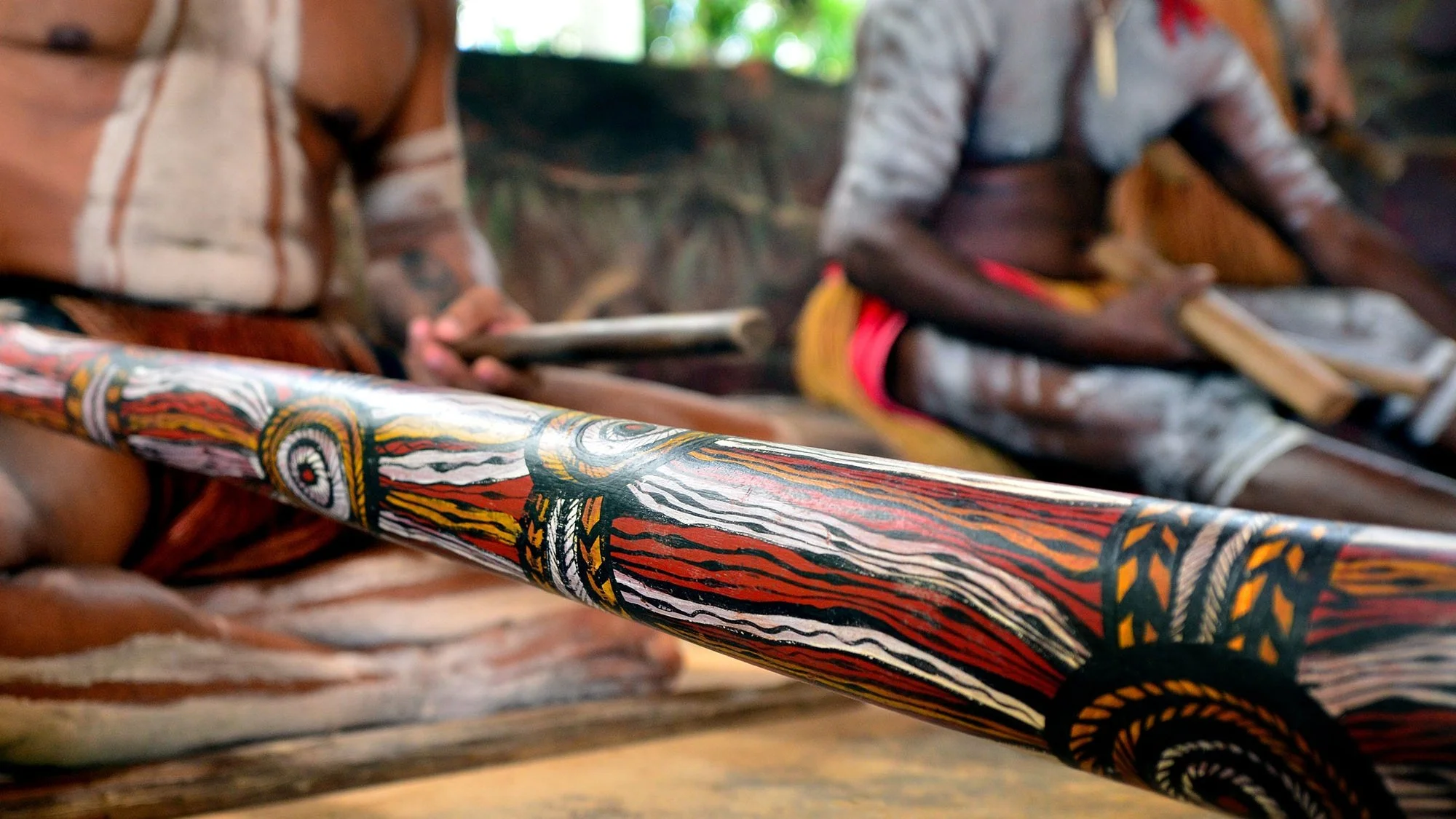
The didgeridoo, known to many Yolŋu communities of northern Australia as the yidaki, is one of the world's oldest wind instruments, built from a eucalyptus branch naturally hollowed by termites. Played using circular breathing to sustain an unbroken drone, it accompanies ceremony, storytelling, and the songs that carry the songlines forward, its low resonance often described as the voice of the land itself.
Aotearoa, Waiata and Haka
In Māori tradition, waiata (song) holds genealogy, grief, celebration, and instruction, sung at gatherings on the marae, the communal meeting ground at the center of Māori social and spiritual life. A karanga, a formal ceremonial call performed by women, opens these gatherings, welcoming visitors and acknowledging ancestors in a chant unaccompanied by instrument, carried by voice alone.
The haka, widely known abroad through sporting events, is in its fullest ceremonial context a form of chant fused with posture, rhythm, and collective breath, historically performed to convey challenge, welcome, mourning, or celebration depending on its form. Traditional Māori instruments, collectively known as taonga puoro, include the pūtātara, a conch shell trumpet, and the kōauau, a small flute, both used in ceremony and increasingly revived in contemporary Māori cultural practice after decades of suppression under colonial rule.
Hawaii, Mele and the Art of Oli
In Hawaiian tradition, mele — chant and song — functioned as the primary vessel for history, genealogy, and spiritual knowledge in a culture that transmitted its deepest teachings orally. Oli, a form of chant performed without instrumental accompaniment or dance, carries particular weight: certain oli were reserved for entering sacred spaces, requesting permission to come ashore, or invoking ancestral lineage, with precise wording and tone understood as essential to their spiritual function.
Hula, often reduced in popular imagination to performance alone, developed as a physical extension of mele — hula kahiko, the older ceremonial style, performed with chant and traditional percussion such as the ipu heke gourd drum, honored deities and ancestors long before hula auana, the gentler, more melodic style familiar to modern audiences, emerged following Western contact.
Papua New Guinea, the Garamut and Kundu Drums
Across the islands and highlands of Papua New Guinea, home to over 800 distinct languages, sacred sound is carried largely through drums built and played with remarkable regional variation. The garamut, a large hollowed log slit-drum, is struck to produce different tones depending on where along its length it is played, allowing skilled players to send coded messages across considerable distances — village to village, and role to role within ceremony.
The kundu, an hourglass-shaped hand drum with a lizard-skin head, accompanies singsing gatherings, large ceremonial festivals where clans gather in elaborate body paint and feathered headdress to sing, dance, and perform songs tied to ancestral spirits, initiation, and clan identity. These gatherings remain vital living practice today, adapted but unbroken across generations.
Fiji, the Lali Drum and Communal Song
In Fiji, the lali, a hollowed wooden slit-drum similar in construction to instruments found elsewhere in Melanesia and Polynesia, has long served both practical and sacred purposes — summoning villagers to gathering, marking the presence of a chief, and announcing ceremony, its carrying tone traditionally understood to reach across a village or between islands.
Communal chant and dance, particularly the meke, weaves sung poetry, choreographed movement, and percussion into a single storytelling form, performed to recount historical events, honor chiefs, or mark significant occasions. As with many Pacific traditions, authorship in meke is often communal rather than individual, composed and refined collectively and passed forward as shared cultural memory rather than a single creator's work.
Micronesia, Chant and the Art of Wayfinding
Across the scattered atolls of Micronesia, particularly in the Caroline Islands, one of the most remarkable sacred sound traditions is bound not to ceremony alone but to survival at sea. Traditional navigators trained for years to memorize star paths, wave patterns, and swell direction, much of it encoded and reinforced through chant, allowing voyagers to cross open ocean between islands separated by hundreds of miles without instruments of any kind.
This navigational knowledge, held by master navigators and transmitted orally across generations, nearly disappeared entirely in the twentieth century before a determined revival — carried forward by figures such as Mau Piailug of Satawal — helped restore and pass the tradition to a new generation. In this context, chant is not separate from technical knowledge. It is the vessel that holds it, memory made portable enough to cross an ocean.
Sound Across the Pacific
What runs beneath all of these traditions — songlines and the didgeridoo, waiata and haka, mele and oli, the garamut and kundu, the lali and meke, and the chanted knowledge of Micronesian navigators — is a shared understanding: that sound can hold what a culture cannot afford to lose. Genealogy, law, memory, and the way home are carried forward, one voice and one drumbeat at a time.
Within the Sacred Syllable, these traditions are honored individually and in depth as this collection continues to grow — each one distinct, each one carrying its own history, language, and relationship to the sacred.