
Sacred Sound in the Age of Artificial Intelligence
A New Vessel for an Old Transmission
Every tradition gathered here has survived because it kept finding new vessels to travel in. A chant first carried by memory alone was eventually written into notation. A mantra passed from teacher to student for centuries was eventually recorded onto tape, then digitized, then streamed. None of this made the practice less sacred. It made it more durable, more able to reach someone who would never have sat in the original room where the sound was first offered.
This site uses artificial intelligence as part of that same lineage of transmission, as a research and creative collaborator in exploring these traditions. That's worth naming plainly, not because it needs defending, but because the honest version of this story is more interesting than the quiet one.
The Question Underneath the Question
Anyone paying attention to how quickly AI systems can now produce plausible-sounding spiritual writing has reason to ask a fair question: what makes a blog about sacred sound worth trusting, when the words themselves could technically be generated by a machine in seconds?
It's a good question, and it deserves a real answer rather than a dismissal. The honest answer is that the words alone were never really the point. A chant, a mantra, a drumbeat, none of these traditions exist primarily as information to be transmitted. They exist as practices, refined over generations by people who tested them against real bodies, real states of consciousness, real communities in need of something words alone couldn't provide. Text about a tradition is only ever a map. It was never the territory, long before AI entered the picture.
What has changed is how easily a compelling-sounding map can now be drawn by something that has never walked the territory at all. That's the real shift, and it's worth taking seriously rather than waving away. A system that has ingested vast amounts of writing about mantra yoga can produce a fluent paragraph about mantra yoga without ever having practiced one, without any lineage of teacher and student behind it, without any felt sense of what changes in the body when a seed syllable is chanted with real attention. Fluency and legitimacy are not the same thing, and the gap between them is exactly where discernment now has to live.
What Cross-Referencing Actually Means
The way this site tries to hold that gap responsibly is through cross-referencing rather than generation for its own sake. A post on Gregorian chant draws on its historical role in the Christian liturgical calendar and its formal function within monastic practice. A post on Zen chanting is checked against its roots in Mahayana teaching, not just its surface aesthetic. When AI is used in drafting, it's used the way a research assistant might be used, gathering, structuring, and helping articulate material that is then checked, cut, and rewritten against actual sources and actual understanding, rather than accepted as a finished authority in itself.
This matters because sacred sound traditions are easy to flatten into vibes. A drumbeat, a Sanskrit syllable, a wash of reverb, all of it can be repackaged into something that sounds spiritual without being rooted in anything real. That flattening was already a risk before AI existed, in the broader wellness industry's long habit of borrowing surface aesthetics from traditions without their context or consent. AI simply makes that flattening faster and cheaper to produce at scale. The corrective isn't to reject the tool. It's to hold a higher standard for what gets published with it, treating accuracy, lineage, and context as non-negotiable rather than optional polish.
The Practice Behind the Page
There's a piece of this that no amount of careful research or cross-referencing alone can supply, and that's direct experience. Kusala Healing Arts, the integrative healing practice this writing sits alongside, offers hands-on sessions where sound, touch, and presence meet in real time, and that's where these traditions actually get tested. A post about drumming's effect on the nervous system means something different coming from someone who has watched a client's breathing change during a session than it does as a purely academic summary.
This is, in the end, the clearest answer to the legitimacy question. AI can help organize and articulate what has been learned. It cannot sit in a room with another person and feel what a particular frequency, rhythm, or held silence does to a nervous system in distress. That felt knowledge, gathered session by session, is the thing no model can generate, and it's the thread that runs underneath every post here, even the ones that read as historical or comparative rather than personal.
Logos as the Oldest Precedent
There's a concept worth returning to often on this site: Logos, the ancient idea of the generative word, the sound or utterance that doesn't just describe reality but participates in bringing it into being. It shows up across traditions in different clothing, the creative speech-act in Egyptian heka, the resonant syllable in Vedic mantra, the Word made flesh in Christian theology, the divine breath in countless creation stories that begin with sound before form.
What all of these traditions share is a recognition that sound and language were never neutral tools. They were understood as forces capable of shaping consciousness and reality itself, which is exactly why they were treated with such care, why certain syllables were reserved for initiates, why certain chants were only taught after years of preparation. That old carefulness is the real model for how a new technology like AI should be approached here as well. Not with fear, and not with careless enthusiasm either, but with the same discernment these traditions have always asked of anyone handling sacred sound: know what you're working with, understand its history, and take responsibility for what you put into the world with it.
A Practical Standard, Not Just a Philosophy
It's worth being concrete about what this actually looks like in practice, rather than leaving it as an abstract commitment. A post on a specific tradition, whether Vietnamese spirit mediumship, the I Ching, or a particular lineage of chant, gets checked against primary texts and recognized scholarship where they exist, not just against whatever a search engine or a language model surfaces first. Claims about a tradition's origin, meaning, or use are traced back toward their source rather than repeated because they sound plausible. Where genuine scholarly disagreement exists, as it does with several of the very artifacts discussed on this site, that disagreement gets named rather than smoothed over into false certainty.
This is slower than simply generating a confident paragraph and publishing it. That slowness is the point. A reader coming to this site to understand mantra yoga, ancestral healing, or the history of sacred drumming deserves writing that has actually sat with the discomfort of not knowing everything, rather than writing that performs certainty because a model was asked to sound authoritative. Discernment, in this sense, isn't a one-time editorial policy. It's a standard applied post by post, source by source, and it's the thing that separates genuine research from content manufactured to fill a page.
Where This Leaves the Reader
None of this resolves the tension entirely, and it probably shouldn't. The right posture toward AI-assisted spiritual writing is ongoing attention, not a settled conclusion reached once and then forgotten. What this site can offer is transparency about the process, a genuine effort at accuracy and cross-cultural respect, and a grounding in actual practice that keeps the writing honest even when the drafting tools are new.
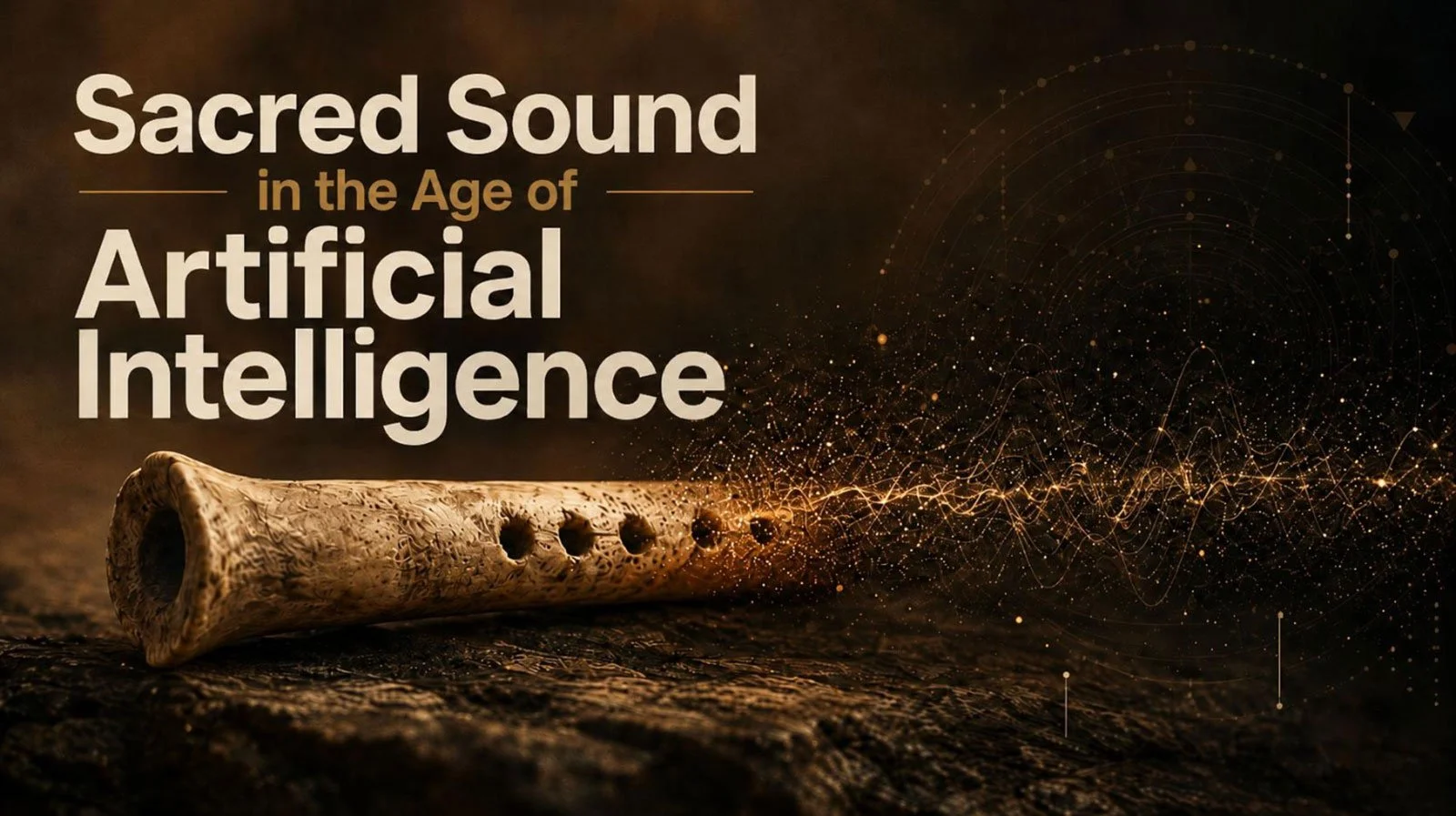
The instruments and traditions explored here, whether a bone flute forty thousand years old or a mantra chanted this morning, all share one thing in common: they were never really about the artifact itself. They were about what the artifact made possible in the person encountering it. That's still the measure worth applying now, to every post on this site, regardless of what tools helped bring it into words. Not whether the writing sounds convincing, but whether it leaves the reader more grounded, more informed, and closer to something true.